Thursday, 20 March 2014

News Programme Rehearsals (4).

In today’s lesson, two groups rehearsed a full run-through of their show. This included VT clips and intros being played throughout the show at the right times.

In Steph, Chloe and Lesley’s group, I am usually a runner, but because Ellis was not in, I took over the role of vision mixing for the lesson because I had made notes on how to insert clips, and also use the green screen/virtual studio.

They had the intro for their news show made, as well as two VT clips. I inserted these by lending them my USB stick for them to put the clips on, and then inserted them into the tri-caster. They also wanted to use the green screen, and so I inserted a New York skyscraper into the background for them.

Stephanie did not manage to get a copy of the script because her phone battery ran out, and so was not able to tell me exactly when she wanted me to cut to each of the three cameras, and therefore I had to try and do the best job I could by listening to the presenters and when they spoke.

Also, they only had two VT clips so they had to work around that, and just do a run through without all of the clips being inserted. It went well apart from that though, and on the day when Ellis is the vision mixer, it should run smoothly in my opinion.


For the second half of the lesson, I was a runner in Josh’s group. However, one of their camera operators were off sick, and so I took over that job for the rest of the day. There wasn’t much to do except for set it up to be where they wanted it, but it all went well and there was no issues with the cameras at all.


Wednesday, 19 March 2014

Character Dialogue.

In lesson, we were given the following two characters:

Debbie Graves, 17, trendy, sarcastic.

Gladys, 52, bored, educated.

We were then asked to write different lines for the two characters.


These were Debbie's lines:

Debbie asks someone to leave a party.
'Oit! We know how much people love you being here, but I think you should leave before they start enjoying your company too much.'

Debbie tells someone that she's in love with them.
'I can't be completely sure, but... I think I like you. I mean, really like you. Possibly even love you.'

Debbie is bored watching a film.
'Jeez, who was the genius that wrote this film? Was it too hard for them to make it interesting, or do they not know the meaning of the word?'


These were Gladys' lines:

Gladys asks someone to leave a party.
'I think you've had one too many drinks, it's probably best for you to leave.'

Gladys tells someone that she's in love with them.
'I really do love you.'

Gladys is bored watching a film.
'Surely this isn't the sort of thing that's classified as 'entertainment' these days?'


We were then asked to do this again with two more characters, and three more lines.

Barney Hill, 5, cheerful, confused.

Jack Deth, 50, hard-boiled cop.

These were Barney's lines:

Barney thinks someone stole something.
'It was there this morning, why ain't it now? Someone must have taken it... Why would they do that?'

Barney is enjoying dinner an awful lot.
'This is really yummy, can we eat this tomorrow night too? And the night after? And the night after that?'

Barney doesn't understand.
'I don't get it, it don't make sense.'


These were Jack's lines:

Jack thinks someone stole something.
(Probably has someone pinned to a wall.)
'Oit you little shit, I know you took it, don't even bother trying to lie to me.'

Jack is enjoying dinner an awful lot.
'This is some great tasting food, we've gotta eat here more often.'

Jack doesn't understand.
'Hang on, hang on, repeat that. You're making no sense.'


Every character should have a unique voice. When re-writing a screenplay, go through and make sure that the character's background and personality is clear with every line of dialogue. Remember that no two characters speak alike!


Re-Writing A Scene.

Ernest Hemingway was an acclaimed author and journalist who gave the world the following quote:
"The first draft of everything is shit."


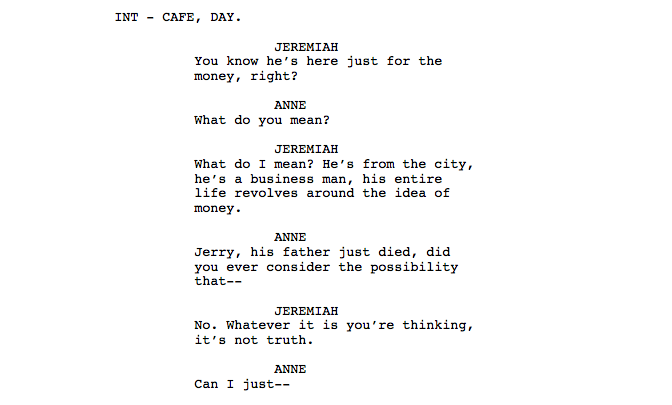
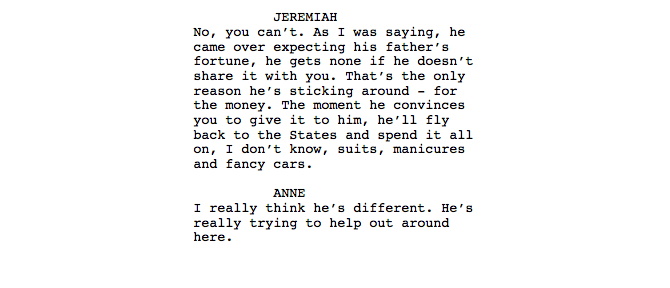
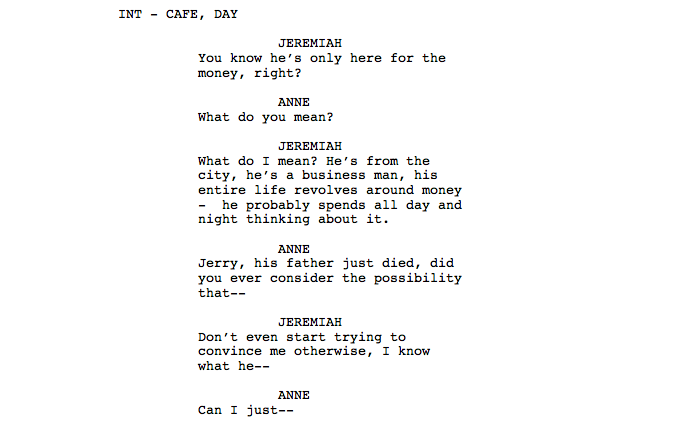
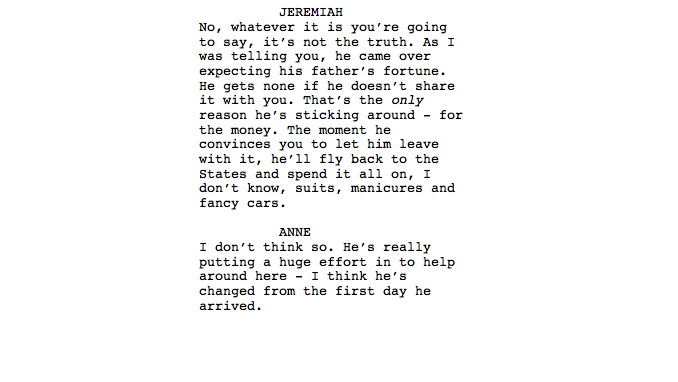
Original, first draft of a conversation from 'Country Life':


This was the filmed version of this scene, using this script:


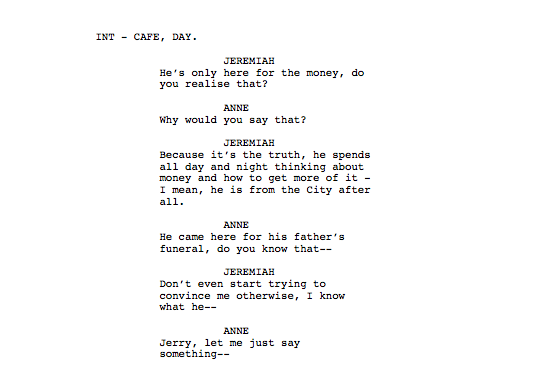
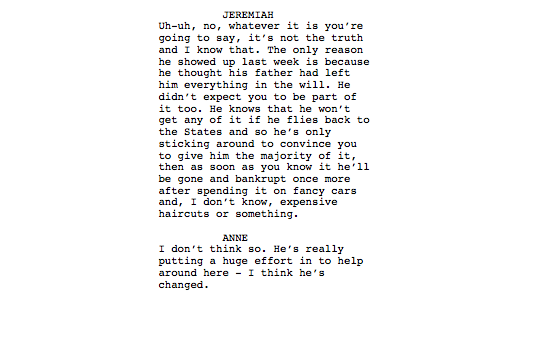
We were asked in today's lesson to re-write the same scene, although changing every word of dialogue whilst keeping the meaning the same. This is the second draft of the scene:

We were then asked to review other people's scripts and see which one they thought was the better version. This is what people had to say about mine:

The first one was better as there are some bits where more emphasis is given like his father died not he came here for his father's funeral

The first draft sounds more realistic, the dialogue between anne and jeremiah where they are interrupting each other sounds as if it could be real dialogue between them.

ace the pro top notch home dog ;)

bro, this is ace.  they are both really good, and now i have read them both, they are both really good. well done peasant, - Jem :3


I have to agree that the first draft is better in my opinion, although some aspects of the dialogue are better in the second and so rather than settle with one of these two, I would rather write a third, with a mix from the better lines of dialogue from each of the drafts.


We were then asked to pick whichever version we preferred (or mix and match lines from the two different versions like I did), and then do a repetition edit. This is where you run through the text and take out any repetition. If a line isn't giving new information then prune it.

As Pat told us in lesson:

"Repetition is the enemy of good dialogue.

Repetition is bad for your dialogue.

Repetition isn't a benefit for your dialogue.

You see what I did there?"


This is the third version of this scene that I re-wrote, combining lines from the first and the second drafts, as well as adding/removing little snippets of dialogue too:


The third thing we had to do was to consider these three lines of dialogue:

'I'm asking you to vacate these premises.'

'You aren't wanted round here.'

'Oi! You got two seconds or I'll make you bleed. GET. OUT.'

They're all asking someone to leave a place, but the way they're written makes it seem like different locations, genres and characters and have a different impact in a film. For example, the first one seems like a security guard, or a police officer asking somebody to leave a property as it's a rather formal way to ask someone to leave. The second one seems like someone from a Western film, when a newcomer makes their way into a new town and they're not welcomed. The last one seems far more aggressive and violent, like something from Eastenders or a gang movie.

If a gangster would say the first line, they instantly change from a common street gangster to someone like a mafia boss who has lots of power and control, and the feel of the dialogue is completely different. If the third line was said by a posh waiter in a fancy restaurant, it sounds completely absurd and sounds like it belongs more in a comedy than a serious film.

Dismissing the very first ideas makes the screenplay more interesting and involving, and so using the second or third ideas that come into your head generally seem to work better for the film.

Thursday, 13 March 2014

Definitions Of Markets And Ownerships.

Ownership.
The conglomerate is the company at the top, that owns a number of different companies. It's at the top of the hierarchy. News Corp would be a conglomerate.

A subsidiary is the smaller companies underneath the large conglomerate, such as 20th Century Fox being owned by News Corp.

A monopoly is when one company owns the majority of the market. Microsoft were once accused of having a monopoly because they were the only company you could really buy a computer from during the 00s. There is no open market and competition, and therefore the company can charge whatever they'd like for their products.

An oligopoly is where just a few companies own the majority of the market - such as the large big six film studios owning 95% of the television and film market in America.

An open market is where there is a more competitive and fairer market with lots and lots of different companies available for consumers to choose from.


Vertical ownership is where all stages of production are kept within the company. Sony, for example, come up with the idea, plan, create, edit and distribute the films they make, and they manage the entire process of the film without other companies getting involved. They can also use Sony software and Sony equipment to film and edit the films, and so everything was made by Sony themselves. Most media conglomerates are set up this way. Benefits of this would be that the idea would be held within the company and maintain control and copyrights of the film. They also wouldn't have to wait for another company to complete parts of the film making, and communication may be easier within the company. The company would receive all the profits for the film too, however, if the film is received badly, they also have to take all of the losses. They also end up producing a lot of similar films so there could be less diversity within the film company.

A horizontal ownership is where production is split between several companies. This is how most independent film studios are set up. One person may come up with the idea and sell the script to a company, who will film it and then give it to an editing house to edit it, and then pass it onto a distribution company to get it out in the cinemas/on DVDs. These films could possibly be more diverse and creative as its not the same people creating the films every time like vertically owned companies do.

Some companies can also be a hybrid of these two models of ownership.


Funding.
Public television stations - such as the BBC - are funded by the public by them paying for their television licences which is not optional.

Private stations are funded by either the government or by people choosing to have a subscription to the station, and therefore paying optionally to receive the service. Executive producers could also fund films and television shows. Adverts on television channels also help to fund the television station. Product placement is allowed in America, and this is where companies pay for their product to feature heavily in the show.

Sponsorship is where a company pays to have their product(s) displayed before and after the show/film and during the breaks and intervals.

Independent film companies could earn money by taking part in film festivals that give cash prizes to winners.


A statute is something set out by the government. For example, the BBC needs to broadcast a certain amount of news, education and entertainment shows because the public are legally required to pay to contribute towards the channel and so it needs to contain a large variety of programmes to make up for it.

Six Questions To Ask A Main Character.

Who is your main character and what do they want?


What are the obstacles they must overcome to get what they want?


In the end, do they get it? Was getting it (or not getting it) good or bad for them?


Why do we care? What's so damn compelling about this story that I should spend 110 minutes of my life watching it?


What does my main character need? How is this different from what they want?


Why now? Why is this story happening to my character now?

Television Broadcasting/Large Film Companies.

We were looking at television channels and discussing whether they are run by the government, owned privately or are a hybrid. Depending on what sort of channel it is affects what they show/display on the television, as certain shows - such as news programmes - could be extremely biased or selective on what they show, especially if it is government run like China's television is.

Some examples of stations sorted into these three categories are:

Government Private Hybrid
Xinhuanet News. Sky. BBC.
AGN (Agencia Guatemalteca de Noticias). Virgin. Channel 4.
RT (Russia Today). ITV.
RIA Novosti. Disney Channel.
Russia 1. Dave.
GOLD.


We also considered the fact that creative media such as films and fictional television shows are mainly run by three large companies. There may seem like there's hundreds and hundreds of companies out there, but they are generally sub-studios of the main five. These are listed below:

Studio parent
(Conglomerate)
Major studio unitArthouse/IndieGenre movie/B movieAnimationOther divisions and brandsU.S./Canada market share (2012)[1]
Sony Pictures
(Sony)
Columbia PicturesSony Pictures ClassicsStage 6 FilmsScreen GemsAffirm FilmsSony Pictures AnimationSony Pictures Releasing,
TriStar Pictures,[2]
TriStar Productions,[3]SPWA[4]
16.9%1
Warner Bros.
(Time Warner)
Warner Bros. PicturesWarner Bros. AnimationCastle RockHBO FilmsNew Line,Turner Entertainment15.3%2
The Walt Disney Studios
(Disney)
Walt Disney PicturesDisneynature,LucasfilmMarvel StudiosDisneyToon StudiosLucasfilm AnimationMarvel AnimationPixarWalt Disney Animation StudiosThe Muppets StudioTouchstone PicturesUTV Software Communications14.7%3
NBCUniversal
(Comcast)
Universal PicturesFocus Features,WT2 ProductionsWorking Title FilmsIllumination EntertainmentUniversal Animation Studios13.7%4
Fox Entertainment Group
(21st Century Fox)
20th Century FoxFox SearchlightFox FaithBlue Sky Studios20th Century Fox AnimationNew Regency Productions (20% equity)10.4%5
Paramount Motion Pictures Group
(Viacom)
Paramount PicturesParamount VantageInsurge PicturesParamount AnimationMTV FilmsNickelodeon Movies8.3%6

News Show Breakdown.

NEWS SHOW BREAKDOWN


Group Name


Group Members
Nicola Sinclair, Jemma Land, David Neale and Connor Sadler.

Job Roles
Crew Member

Producer
Nicola Sinclair

Director
Jemma Land

Floor Manager
David Neale

Script Writer
Connor Sadler

Art Director
Ashley Hodges

Vision Mixer
Ellis Bishop

Sound 1
Frankie

Sound 2
Deanna Ricketts

Lighting 1
Joshua Bates

Lighting 2
Joe

Camera 1
Chloe Pearce

Camera 2
Rory

Camera 3
Lesley Cross

Presenter 1
Chris

Presenter 2
Stephanie Preston

Runner
Maddie

Runner
Corey


Time
Action
Notes
1:45pm
Lesson start.
5 minutes to make sure latecomers arrive.
1:50pm
Setup studio floor.
Following floor plan, table, sofa and chair put in position.
2:00pm
Set up cameras.
Runners need to tape wires down.
2:20pm
Set up lighting.

2:30pm
Set up microphones/audio.
Silence in studio whilst audio is tested.
2:40pm
Test audio/microphones.

2:45pm
Test VT clips/introduction/outros.

2:55pm
First run through.
Makes notes on what needs changing.
3:15pm
Break.
15 mins.
3:30pm
Make any changes that are needed.

3:40pm
Second run through.

4:00pm
Make any additional changes.

4:10pm
Live recording.

4:40pm
Pack equipment away.